
By Thom Salo, COL USA (Ret), NASM CPT, 5x Ironman, Longevity Director Updated July 21, 2026
If you sauna, cold plunge, or use contrast therapy, you’ve probably heard that cold exposure can interfere with your workout gains. That’s true, but only for one specific type of training. Understanding the difference changes everything about how you time your recovery. The short answer: cold blunts muscle growth after strength work; it does not interfere with endurance adaptations. Heat helps both. This guide explains why, and how to sequence heat and cold based on what you trained.
What is contrast therapy?
Contrast therapy is the sequential alternation of heat exposure (sauna) and cold exposure (cold plunge or cold water immersion). The practice originates in Finnish and Nordic cultures where it has been in daily use for thousands of years. In the last two decades, a body of peer-reviewed research has caught up with tradition and mapped the specific physiological mechanisms that make contrast therapy effective: vascular pumping, autonomic nervous system training, hormonal cascade activation, heat shock protein expression, and norepinephrine release.
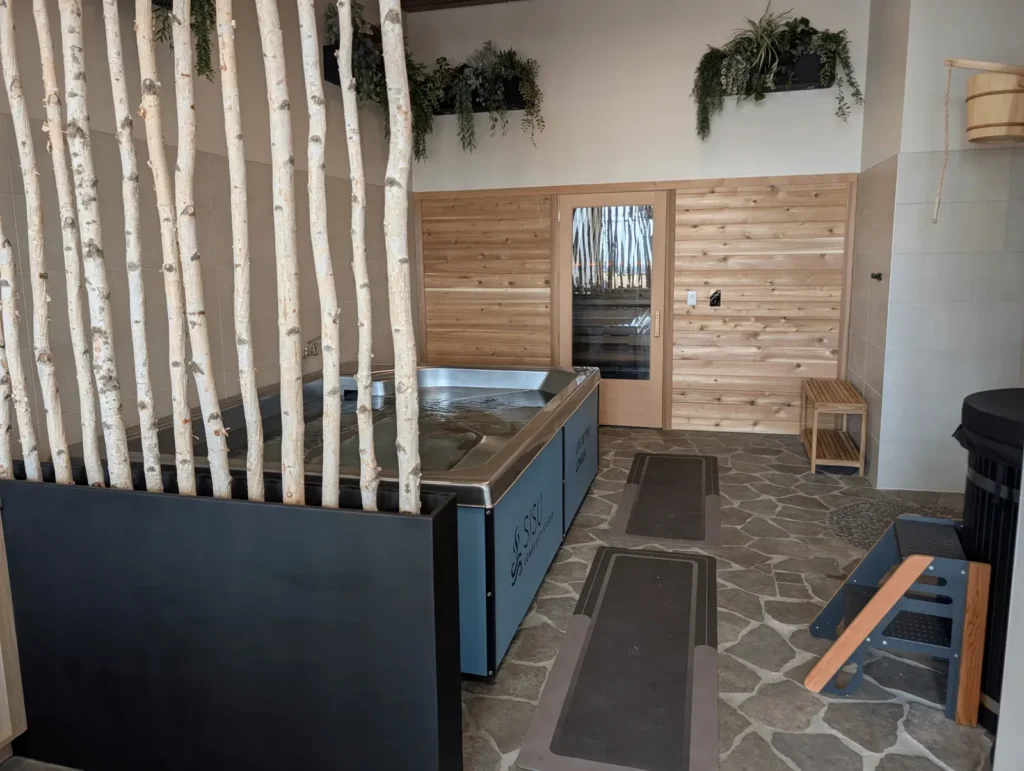
At Sisu Longevity Studio we offer authentic Finnish-style contrast therapy: a traditional wood-lined dry sauna with heated stones and löyly (water poured on the stones for steam), a commercial-grade cold plunge, and a dedicated relaxation lounge for the recovery phase between rounds.
This guide focuses on the practical question most members ask on their first visit: based on what I just trained, should I sauna, cold plunge, or do full contrast?
The two adaptation pathways
Your body adapts to exercise through two distinct biological pathways, the structural pathway and the metabolic pathway, and they do not respond to cold the same way.
The structural pathway is what drives muscle growth after strength training. Squats, deadlifts, resistance work. When you lift heavy you create microscopic muscle fiber damage. Your body repairs that damage through an inflammatory response driven by a protein called mTOR (mechanistic target of rapamycin), rebuilding the tissue larger and stronger than before (Bodine et al., 2001). The inflammation is the adaptation signal, not a side effect to be managed. Cold exposure directly suppresses this inflammatory cascade, which is why cold water immersion after resistance training has been shown to measurably reduce long-term muscle growth and strength gains (Roberts et al., 2015; Fyfe et al., 2019).
The metabolic pathway is what drives endurance adaptations. More mitochondria, better oxygen delivery, improved cardiac output, enhanced fat burning, faster lactate clearance. These adaptations are triggered by energy demand through different molecular signals, AMPK (AMP-activated protein kinase) and PGC-1α (peroxisome proliferator-activated receptor gamma coactivator 1-alpha), not by tissue damage (Jäger et al., 2007). There’s no inflammatory repair cycle to protect. Cold exposure doesn’t interfere with any of it (Jäger et al., 2007; Ihsan et al., 2015).
This distinction drives all timing decisions.
After strength training
Skip the cold plunge. Sauna is safe and it helps. Heat shock proteins protect newly synthesized muscle proteins and guide proper folding (Kregel, 2002; Selsby et al., 2007). Growth hormone elevation is among the documented endocrine responses to repeated sauna exposure (Laukkanen & Kunutsor, 2024). Blood flow increases nutrient delivery to damaged fibers. None of this interferes with the mTOR signaling your muscles need. Heat and cold have opposite effects on the structural pathway: heat supports it, cold blunts it.
Wait at least 3 to 4 hours before any cold exposure after strength work. The blunting effect is acute. It’s the post-workout window that matters most. A cold plunge tonight won’t affect tomorrow morning’s strength session. If you want sauna-only on strength days, that’s the cleanest approach.
After endurance training
Full contrast therapy is a green light, at any intensity, in any endurance sport. This applies equally to Zone 2 base rides, threshold intervals, VO2 max repeats, long runs, masters swim sessions, and everything in between. The adaptations you’re building are metabolic, not structural. Cold doesn’t touch them (Jäger et al., 2007; Ihsan et al., 2015).
Cycling, swimming, and rowing get the cleanest pass because they’re almost entirely concentric. The muscles shorten under load without a significant eccentric (lengthening) phase (LaStayo et al., 2003). The pedal doesn’t resist you on the way up. The water doesn’t pull your arm back. Even an all-out sprint on the bike produces metabolic and neural adaptations, not structural ones.
Running includes a small eccentric component. Every footstrike absorbs 2 to 3 times your bodyweight. Research has not shown meaningful impairment of endurance adaptations from post-run cold exposure (Broatch et al., 2014). If you want to be cautious after an extremely long or downhill-heavy run, waiting 1 to 2 hours is reasonable, but it’s a minor consideration, not a strong contraindication.
On recovery or off days
The best time for full contrast therapy. No training adaptations to protect, and the cardiovascular, hormonal, and autonomic benefits, vascular pumping for waste clearance (Cochrane, 2004), norepinephrine for mood and metabolism (Šrámek et al., 2000; Søberg et al., 2021), and parasympathetic restoration (Stanley et al., 2015), support your recovery from prior training days. This is also where your weekly accumulation of sauna and cold minutes builds toward the research targets that drive long-term health outcomes (Laukkanen et al., 2015; Søberg et al., 2021).
Quick-reference decision table
| After this training | Sauna | Cold plunge | Full contrast |
| Strength / resistance work | Actively supports recovery | Blunts mTOR signaling | Sauna only. Defer cold 3 to 4+ hours. |
| Cycling (any intensity) | Compounds benefits | No interference | Full contrast. End on cold. |
| Running (most sessions) | Compounds benefits | No interference | Full contrast. End on cold. |
| Swimming / rowing | Compounds benefits | No interference | Full contrast. End on cold. |
| Recovery or off day | HSPs, parasympathetic shift | Norepinephrine, metabolism | Optimal. No adaptations to protect. |
How contrast therapy works (and why sequence matters)
Contrast therapy is more than “sauna plus cold plunge.” The sequential alternation creates physiological effects that neither modality produces alone.
Heat causes vasodilation. Blood vessels widen, blood flow increases to peripheral tissues, and nutrient delivery accelerates. Cold causes vasoconstriction. Blood vessels narrow, blood is driven back toward the core, and metabolic waste is flushed from tissues. Alternating between the two creates an active pumping action that moves fluid through recovering muscles more effectively than either stimulus alone (Cochrane, 2004; Bieuzen et al., 2013).
Beyond the circulatory benefit, the alternation trains your autonomic nervous system. The ability to shift smoothly between sympathetic (“fight or flight”) and parasympathetic (“rest and digest”) states (Stanley et al., 2015). That autonomic flexibility is itself a longevity marker. A nervous system that can rapidly respond to and recover from stress is more resilient than one stuck in either gear (Laukkanen et al., 2015).
The Søberg Protocol
The research-backed sequence for maximum metabolic benefit (Søberg et al., 2021; Søberg, 2022):
- Heat first. 15 to 20 minutes in the sauna at 80 to 100°C (176 to 212°F).
- Cold second. 2 to 4 minutes, uncomfortably cold but safe.
- End on cold. Do not rewarm artificially.
- Allow shivering. This activates brown fat thermogenesis, the metabolic benefit.
- Multiple rounds amplify the vascular pumping effect; the final round always ends on cold.
The reason you end on cold: your body’s effort to rewarm itself is the benefit. Shivering and non-shivering thermogenesis through brown fat activation pull glucose and fatty acids from the bloodstream to generate heat (Šrámek et al., 2000; Søberg et al., 2021). Toweling off and dressing is fine. A hot shower or returning to the sauna defeats the purpose.
Weekly targets worth knowing
Research supports specific weekly accumulation targets for long-term cardiovascular and metabolic benefits:
- Sauna: 57+ minutes per week, with optimal benefits observed at 2 to 3 hours per week across 4 to 7 sessions (Laukkanen et al., 2015).
- Cold exposure: 11 minutes per week total, distributed across 2 to 4 sessions (Søberg et al., 2021).
These are accumulation targets, not per-session minimums. Short, consistent sessions across the week are more effective than one long session.
Combined training days
For members who strength train and do endurance work on the same day:
| Sequence | Contrast therapy guidance |
| Strength AM → Endurance PM | Full contrast after endurance (4+ hours post-strength) |
| Endurance AM → Strength PM | Contrast between sessions is fine. Sauna-only after strength. |
| Endurance only | Anytime post-workout |
| Strength only | Sauna post-workout. Defer cold 3 to 4+ hours or next day. |
Getting to the studio after your workout
Most members don’t have a sauna and cold plunge at home. You train at your gym, on the road, in the pool, and then you need to get to the studio. Does the drive cost you recovery benefits?
No. After endurance training, the vascular pumping benefit is most useful while metabolic waste products are still elevated, but that window is generous. Metabolic byproducts remain elevated for several hours. Arriving 30 to 90 minutes post-workout is ideal, and even 2 to 3 hours later you still capture heat shock protein activation (Kregel, 2002; Selsby et al., 2007), endocrine responses including growth hormone (Laukkanen & Kunutsor, 2024), parasympathetic recovery (Stanley et al., 2015), and the cumulative plasma volume expansion that builds over weeks of regular sauna use (Scoon et al., 2007; Zurawlew et al., 2016).
After strength training, the delay actually helps. You want to keep cold away from the mTOR signaling window. A morning lift followed by an afternoon or evening studio visit lands in the right window. The acute signaling has closed, and you’re clear for the full contrast protocol. Even sauna-only within the first couple hours is productive, since heat supports rather than interferes with the strength adaptation pathway.
On recovery or off days, timing is wide open. Come in whenever it works for your schedule. The weekly accumulation of sauna and cold minutes matters more than the clock on any single session.
Build your studio visits into your weekly rhythm the same way you plan your training sessions. The physiology is forgiving about timing. Consistency over weeks is what produces the result.
The Ritual: how Sisu integrates this protocol
Everything in this guide is protocol math. Match the training to the recovery, get the timing right, accumulate the weekly minutes. In practice, nobody pulls up a spreadsheet while they’re still catching their breath after a workout.
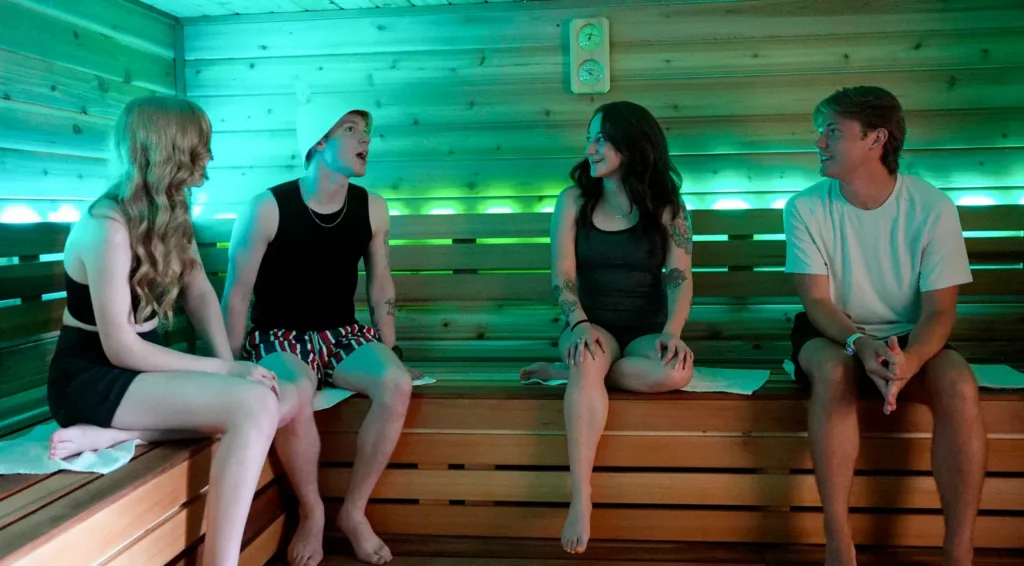
The Ritual is how we solve that at Sisu. After every Training Lab cohort session, your Coach states the recovery protocol for that day’s workout and walks the cohort to the sauna together. Four reserved seats. Cold plunge optional, but sequenced correctly for what you just trained.
- Strength-dominant day (hinge or squat focus). Sauna only. No cold. The Coach will remind you.
- Strength day with a metabolic finisher. Sauna, then an optional short cold at the very end. Timed to protect mTOR signaling.
- Conditioning or cardio-dominant day. Full contrast protocol. Sauna, cold, repeat, end on cold.
You do the training. Your Coach carries the protocol.
There’s also a social piece that matters. The cohort you train with is the cohort you sauna with. Sisu’s cohorts are four people who showed up, did the work, and then sat together in the heat. That shared recovery window is where the community happens. It’s part of the model, not a marketing element.
Recovery-only members and guests run the protocols above with help from a Longevity Technician on their first session.
Related modalities at Sisu
- Float therapy: for the nervous system recovery and sensory reduction benefits without the thermal stress
- mHBOT (mild hyperbaric oxygen therapy): a different recovery pathway through oxygen enrichment and pressurization
- Halotherapy: respiratory support that pairs well with sauna sessions
- Red light therapy: cellular-level recovery through photobiomodulation
Experience Contrast Therapy at Sisu
Three ways to begin:
- Schedule a free tour: see the studio, meet the team, no commitment.
- Explore membership tiers: pricing, packs, and how contrast therapy fits into the Sisu approach.
- Book a single session: drop in and try it.
A complete white paper version of this guide, with the full molecular biology, sport-specific nuances, and expanded research citations, is available on the Sisu Resources page.
Live Better … Longer.
References
- Bodine, S.C., et al. (2001). Akt/mTOR pathway is a crucial regulator of skeletal muscle hypertrophy and can prevent muscle atrophy in vivo. Nature Cell Biology, 3(11), 1014-1019. DOI: 10.1038/ncb1101-1014
- Bieuzen, F., Bleakley, C.M., & Costello, J.T. (2013). Contrast water therapy and exercise induced muscle damage: a systematic review and meta-analysis. PLoS ONE, 8(4), e62356. DOI: 10.1371/journal.pone.0062356
- Broatch, J.R., Petersen, A., & Bishop, D.J. (2014). Postexercise cold water immersion benefits are not greater than the placebo effect. Medicine & Science in Sports & Exercise, 46(11), 2139-2147. DOI: 10.1249/MSS.0000000000000348
- Cochrane, D.J. (2004). Alternating hot and cold water immersion for athlete recovery: a review. Physical Therapy in Sport, 5(1), 26-32. DOI: 10.1016/j.ptsp.2003.10.002
- Fyfe, J.J., Broatch, J.R., Trewin, A.J., Hanson, E.D., Argus, C.K., Garnham, A.P., Halson, S.L., Polman, R.C., Bishop, D.J., & Petersen, A.C. (2019). Cold water immersion attenuates anabolic signalling and skeletal muscle fiber hypertrophy, but not strength gain, following whole-body resistance training. Journal of Applied Physiology, 127(5), 1403-1418. DOI: 10.1152/japplphysiol.00127.2019
- Ihsan, M., et al. (2015). Regular postexercise cooling enhances mitochondrial biogenesis through AMPK and p38 MAPK in human skeletal muscle. American Journal of Physiology: Regulatory, Integrative and Comparative Physiology, 309(3), R286-R294. DOI: 10.1152/ajpregu.00031.2015
- Jäger, S., Handschin, C., St-Pierre, J., & Spiegelman, B.M. (2007). AMP-activated protein kinase (AMPK) action in skeletal muscle via direct phosphorylation of PGC-1α. Proceedings of the National Academy of Sciences, 104(29), 12017-12022. DOI: 10.1073/pnas.0705070104
- Kregel, K.C. (2002). Heat shock proteins: modifying factors in physiological stress responses and acquired thermotolerance. Journal of Applied Physiology, 92(5), 2177-2186. DOI: 10.1152/japplphysiol.01267.2001
- LaStayo, P.C., et al. (2003). Eccentric muscle contractions: their contribution to injury, prevention, rehabilitation, and sport. Journal of Orthopaedic & Sports Physical Therapy, 33(10), 557-571. DOI: 10.2519/jospt.2003.33.10.557
- Laukkanen, T., Khan, H., Zaccardi, F., & Laukkanen, J.A. (2015). Association between sauna bathing and fatal cardiovascular and all-cause mortality events. JAMA Internal Medicine, 175(4), 542-548. DOI: 10.1001/jamainternmed.2014.8187
- Laukkanen, J. A., & Kunutsor, S. K. (2024). The multifaceted benefits of passive heat therapies for extending the healthspan: A comprehensive review with a focus on Finnish sauna. Temperature, 11(1), 27-51. DOI: 10.1080/23328940.2023.2300623
- Roberts, L.A., et al. (2015). Post-exercise cold water immersion attenuates acute anabolic signalling and long-term adaptations in muscle to strength training. Journal of Physiology, 593(18), 4285-4301. DOI: 10.1113/JP270570
- Scoon, G.S., et al. (2007). Effect of post-exercise sauna bathing on the endurance performance of competitive male runners. Journal of Science and Medicine in Sport, 10(4), 259-262. DOI: 10.1016/j.jsams.2006.06.009
- Selsby, J.T., et al. (2007). Intermittent hyperthermia enhances skeletal muscle regrowth and attenuates oxidative damage following reloading. Journal of Applied Physiology, 102(4), 1702-1707. DOI: 10.1152/japplphysiol.00722.2006
- Søberg, S., et al. (2021). Altered brown fat thermoregulation and enhanced cold-induced thermogenesis in young, healthy, winter-swimming men. Cell Reports Medicine, 2(10), 100408. DOI: 10.1016/j.xcrm.2021.100408
- Søberg, S. (2022). Interview: Dose-response thresholds for cold and heat exposure (episode and derivative clips). The Huberman Lab Podcast. Retrieved from https://www.youtube.com/watch?v=7aYArAYghUA
- Šrámek, P., Šimečková, M., Janský, L., Šavlíková, J., & Vybíral, S. (2000). Human physiological responses to immersion into water of different temperatures. European Journal of Applied Physiology, 81(5), 436-442. DOI: 10.1007/s004210050065
- Stanley, J., Halliday, A., D’Auria, S., Buchheit, M., & Leicht, A.S. (2015). Effect of sauna-based heat acclimation on plasma volume and heart rate variability. European Journal of Applied Physiology, 115(4), 785-794. DOI: 10.1007/s00421-014-3060-1
- Zurawlew, M.J., Walsh, N.P., Fortes, M.B., & Potter, C. (2016). Post-exercise hot water immersion induces heat acclimation and improves endurance exercise performance in the heat. Scandinavian Journal of Medicine & Science in Sports, 26(7), 745-754. DOI: 10.1111/sms.12638