
By Thom Salo, COL USA (Ret), NASM CPT, 5x Ironman, Longevity Director Updated May 11, 2026
Vibroacoustic therapy delivers precise low-frequency sound vibrations directly into the body through transducers built into a specialized lounger. Unlike listening to music through speakers or headphones, you feel these frequencies resonating through muscle, bone, and connective tissue. The body is the receiver, not the ear. The modality was developed in Northern Europe in the 1980s, primarily by Norwegian therapist Olav Skille, and has been used clinically for pain reduction, anxiety management, and recovery ever since. Sessions at Sisu run thirty minutes, fully clothed, with no preparation required.
What is Vibroacoustic Therapy?
Vibroacoustic therapy uses low-frequency sound (typically in the 30 to 120 Hz range) to deliver mechanical vibration through specialized transducers in contact with the body. The transducers are integrated into a chair or lounger. The user lies back, the program runs, and the body experiences the vibrations as a slow, deep, internal pulse.
The modality has a documented clinical history. Olav Skille, working in Norway in the 1980s, developed the original vibroacoustic protocols for use with people who had severe disabilities, where conventional therapy options were limited. The technique spread across Scandinavia and into clinical research programs at universities, hospitals, palliative care settings, and rehabilitation centers. The modern wellness-market version, including the LEC MindSync 2.0 used at Sisu, brings the same physical principles into recovery use for a broader population.
A typical vibroacoustic session at Sisu is thirty minutes. The user remains fully clothed. There is no preparation, no skill component, and no learning curve. Most users describe feeling notably calmer afterward, often more so than they expected from a session that asks nothing of them.
The Mechanism: Why You Feel It Instead of Hearing It
Sound and vibration are the same physical phenomenon at different frequencies. The human ear hears most efficiently in the 1,000 to 4,000 Hz range, where the eardrum and middle ear are designed to amplify pressure waves. As frequencies drop below 200 Hz, the ear’s efficiency decreases. Below about 100 Hz, the body increasingly senses these frequencies through the skin, the bones, and the deeper mechanoreceptors of fascia and muscle rather than through the auditory pathway alone.
This is the physical basis of vibroacoustic therapy. The transducers in the MindSync 2.0 generate precisely-tuned low-frequency vibrations. Those vibrations travel through the lounger surface and into the body. Skin mechanoreceptors register them first. Deeper structures, including muscle, bone, and fascial tissue, receive the vibration through direct mechanical conduction. The signal is felt as a slow internal pulse rather than heard as sound.
The nervous system responds to this input. Studies have documented shifts in parasympathetic activity, muscle tone, breathing pattern, and pain perception during and after vibroacoustic sessions. The exact frequency- and dose-response are still being worked out in the research, but the autonomic responses are physiological rather than purely psychological.
The framing that helps: vibroacoustic therapy is not music for the ears. It is targeted mechanical input for the nervous system, delivered through the same physics that lets you feel a subwoofer in your chest at a concert.
The Science: A Maturing Evidence Base
Vibroacoustic therapy has a documented research history going back to Olav Skille’s foundational Norwegian work in the 1980s (Skille, Wigram, & Weekes, 1989). The modern clinical research base is smaller than for some other recovery modalities, and the honest framing is to lead with the strongest evidence and clearly mark where the science is still developing.
Parkinson’s disease motor symptoms. The strongest single piece of evidence in the vibroacoustic literature. Mosabbir, Almeida, and Ahonen (2020) ran a 12-week double-blinded randomized controlled trial in 36 people with Parkinson’s disease. Forty-hertz physioacoustic vibration produced significant motor improvement compared to a placebo control, with 76 percent of treated participants reaching the threshold for clinically meaningful change. The proposed mechanism involves modulation of thalamocortical oscillatory activity in the basal ganglia (Leuk, Low, & Teo, 2020).
Pain in adult chronic pain populations. A 2022 scoping review by Kantor and colleagues synthesized 20 vibroacoustic studies in adults with pain. The review concluded the evidence is consistent with a beneficial effect but that more rigorously designed randomized trials are needed to establish efficacy definitively. A 12-week pilot study by Lim and colleagues (2018) in 23 people with chronic shoulder and low back pain reported clinically meaningful reductions in pain scores and disability measures.
Autonomic nervous system effects. Sandler and colleagues (2017) documented a significant reduction in skin conductance (a marker of sympathetic arousal) in 42 psychosomatic patients after a vibroacoustic session, consistent with a parasympathetic shift. A 2022 randomized crossover study by Vilímek and colleagues found that heart rate variability and subjective stress changed after low-frequency sessions, but the differences between active and placebo conditions were mostly non-significant. The honest read: many users feel a real autonomic shift, and the placebo component in the controlled research is substantial.
Fibromyalgia. Naghdi and colleagues (2015) reported improvements in fibromyalgia symptoms, sleep, and pain in a 19-person open-label pilot at 40 Hz. The lack of a control group limits the strength of the conclusion. The most-cited modern fibromyalgia randomized trial in this literature was retracted in 2020 and is not included here.
Where the literature is thinner (sleep as a standalone outcome, cortisol changes, long-term cumulative effects), Sisu does not overclaim. The strongest case for vibroacoustic remains where the research is strongest: motor symptoms in Parkinson’s disease, pain reduction in chronic pain populations, and consistent autonomic shifts in stress-related conditions.
What Makes Sisu’s Vibroacoustic Different
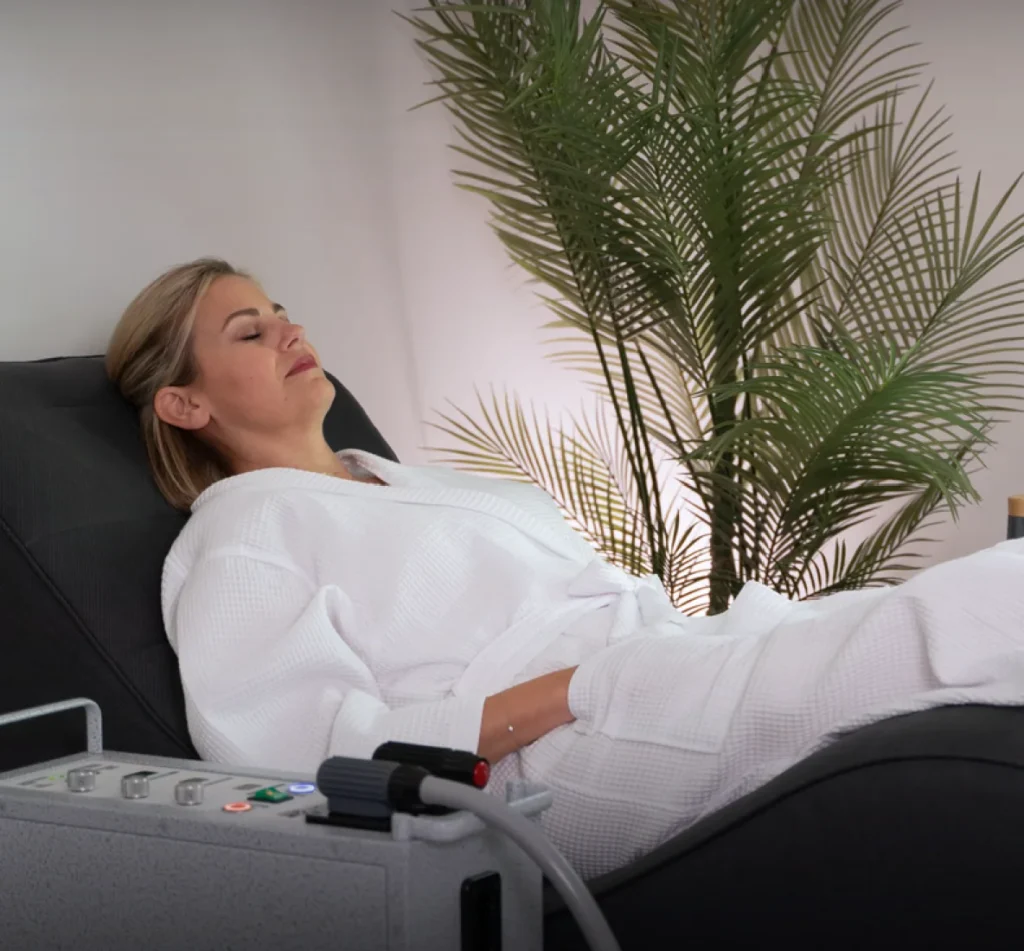
Sisu uses the Living Earth Crafts MindSync 2.0 Harmonic Wellness Lounger, a zero-gravity chair with integrated vibroacoustic transducers designed for clinical and wellness settings. A few details matter.
Zero-gravity positioning. The lounger holds the body in a recline that distributes weight evenly and minimizes pressure on the spine and joints. This is not just about comfort. Pressure distribution affects how vibration is conducted through the body. A correctly positioned body receives vibration cleanly; a poorly positioned body has signal interference from compressed tissue.
Multi-zone transducers. The MindSync 2.0 places transducers at multiple points along the body so the vibration reaches the upper back, lower back, hips, and legs rather than concentrating in one location. The result is whole-body exposure rather than a localized treatment.
Pre-programmed sessions. The system runs programmed sequences of frequencies and intensities matched to specific goals. A relaxation session is structured differently than a recovery session, which is structured differently again than a sleep-prep session. The user chooses the program; the system handles the rest.
Integration with the rest of the recovery stack. Vibroacoustic pairs well with the other modalities at Sisu. Many members use vibroacoustic to downregulate the nervous system before contrast therapy, before a float session, or as a closer after a strength training day. The vibroacoustic session reduces sympathetic tone, which makes everything else work better.
What a Session Looks Like at Sisu
A typical vibroacoustic session at Sisu runs thirty minutes.
The user changes into comfortable clothing if they prefer, though street clothes are fine. They settle into the MindSync 2.0 in the recovery area. Sisu staff walk through program selection for the first session; subsequent sessions are run independently. The lounger inclines into zero-gravity position, the program starts, and the vibrations begin.
The experience is hard to convey without trying it. Most users describe it as a deep, smooth vibration that seems to come from inside the body rather than from a machine. It is not buzzing. It is not rattling. It is closer to the feeling of a low-frequency note held through a long pause, felt rather than heard.
During the session, the user can close their eyes, breathe, or simply rest. Many members report drifting in and out of light sleep. Others stay alert but notably relaxed. Either is fine. The autonomic effects do not require attention to the experience.
The session ends when the program completes. Most users report feeling unusually calm and physically loose immediately afterward, with the effect persisting through the evening. Wearable users sometimes report measurable HRV shifts that show up on the day’s data.
Experience Vibroacoustic Therapy at Sisu
Three ways to begin:
- Schedule a free tour: see the studio, meet the team, no commitment.
- Explore membership tiers: pricing, packs, and how vibroacoustic therapy fits into the Sisu approach.
- Book a single session: drop in and try it.
References
- Kantor, J., Campbell, E. A., Kantorová, L., Marečková, J., Regec, V., Karasová, K., & Sedláčková, D. (2022). Exploring vibroacoustic therapy in adults experiencing pain: a scoping review. BMJ Open, 12(4), e046591. DOI:10.1136/bmjopen-2020-046591
- Leuk, J. S. P., Low, L. L. N., & Teo, W.-P. (2020). An Overview of Acoustic-Based Interventions to Improve Motor Symptoms in Parkinson’s Disease. Frontiers in Aging Neuroscience, 12, 243. DOI: 10.3389/fnagi.2020.00243
- Lim, E., Lim, R., Suhaimi, A., Chan, B. T., & Wahab, A. K. A. (2018). Treatment of chronic back pain using indirect vibroacoustic therapy: A pilot study. Journal of Back and Musculoskeletal Rehabilitation, 31(6), 1041-1047. DOI: 10.3233/BMR-171042
- Mosabbir, A., Almeida, Q. J., & Ahonen, H. (2020). The Effects of Long-Term 40-Hz Physioacoustic Vibrations on Motor Impairments in Parkinson’s Disease: A Double-Blinded Randomized Control Trial. Healthcare, 8(2), 113. DOI: 10.3390/healthcare8020113
- Naghdi, L., Ahonen, H., Macario, P., & Bartel, L. (2015). The effect of low-frequency sound stimulation on patients with fibromyalgia: a clinical study. Pain Research and Management, 20(1), e21-e27. DOI: 10.1155/2015/375174
- Sandler, H., Fendel, U., Buße, P., Rose, M., Bösel, R., & Klapp, B. F. (2017). Relaxation induced by vibroacoustic stimulation via a Body Monochord and via relaxation music: A randomized controlled study in patients with psychosomatic disorders. PLoS ONE, 12(1), e0170411. DOI: 10.1371/journal.pone.0170411
- Skille, O., Wigram, T., & Weekes, L. (1989). Vibroacoustic Therapy: The Therapeutic Effect of Low Frequency Sound on Specific Physical Disorders and Disabilities. British Journal of Music Therapy, 3(2), 6-10. DOI: 10.1177/135945758900300202
- Vilímek, Z., Kantor, J., Krejčí, J., Janečka, Z., Jelínková, D., Kantorová, L., & Campbell, E. A. (2022). The Effect of Low Frequency Sound on Heart Rate Variability and Subjective Perception: A Randomized Crossover Study. Healthcare, 10(6), 1024. DOI: 10.3390/healthcare10061024
Sisu Longevity Studio | 10855 Hidden Pool Heights, Suite 140 | Colorado Springs, CO 80908