
By Thom Salo, COL USA (Ret), NASM CPT, 5x Ironman, Longevity Director Updated May 11, 2026
The Sisu Cohort is a 16-week small-group training program built on a single question: what do you want to be able to do in your last decade? Hike with your grandchildren at 80. Get off the floor without help at 90. Travel independently at 95. Every one of those answers has a measurable physical demand, and every one of them is trainable. The cohort is how we train it. Four members, twice a week, the same coach, the same time slot, for sixteen weeks. The methodology comes from Mike Boyle’s MBSC functional training system and the NASM Corrective Exercise framework. The longevity focus is ours.
What is the Sisu Cohort?
The cohort is the core of the Sisu Longevity Training Lab. Members enroll in a small group of up to four people who train together on the same schedule for sixteen weeks. Cohorts are paired by training days: M/W cohorts train Monday and Wednesday, T/Th cohorts train Tuesday and Thursday. The same four members, the same coach, the same time slot, twice a week.
The program runs in three progressive phases over the sixteen weeks. Accumulation builds work capacity and pattern quality. Strength loads the patterns. Power introduces ballistic and explosive elements where the member is ready for them. The coach knows where each person started and where they are now. The cohort makes progressive overload possible in a way that drop-in classes and self-directed training cannot.
Membership is month-to-month. The sixteen-week cycle is the program structure, not a prepaid commitment.
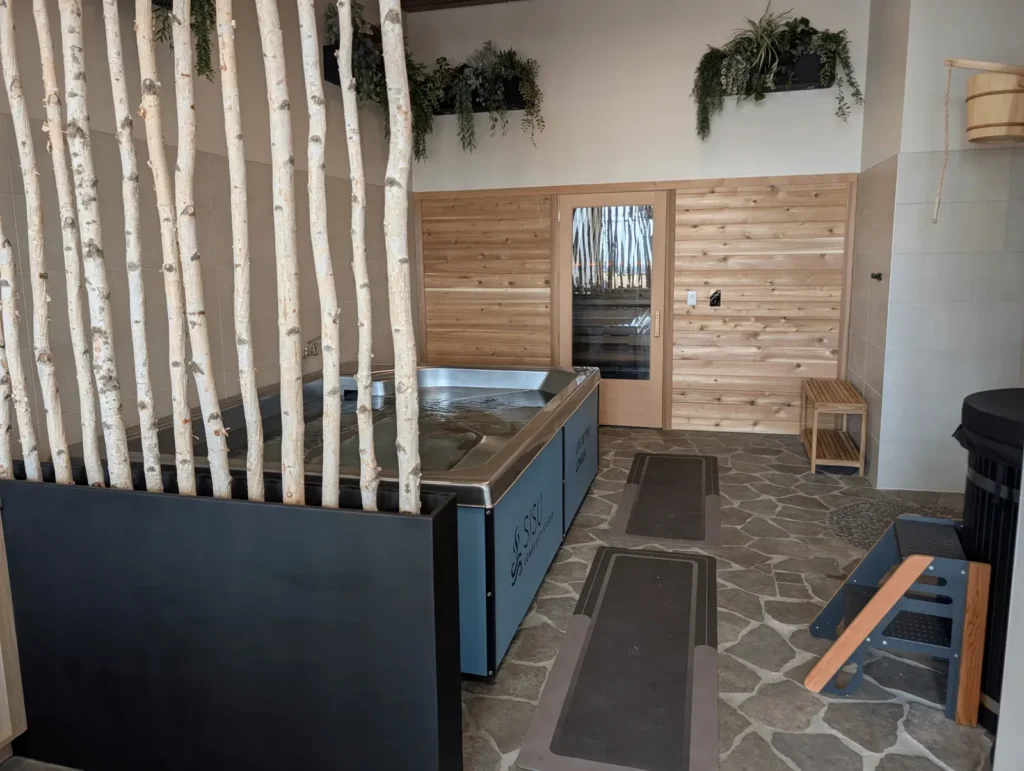
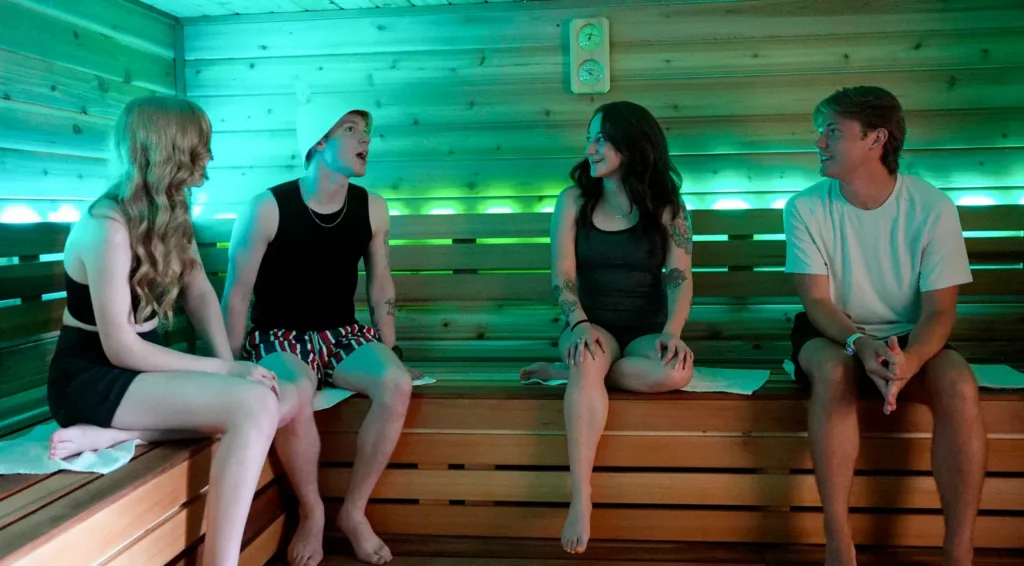
Every coached session ends the same way: the cohort moves from the training floor to the sauna together. This is The Ritual, and it is part of the membership, not an add-on.
The Method: Boyle MBSC, NASM CES, Adapted for Longevity
The Sisu training methodology has two parents and one focus.
The first parent is Mike Boyle’s Mass Boyle Strength and Conditioning (MBSC) functional training model. Boyle’s system, refined over four decades and documented in his book Advances in Functional Training, is the gold standard for functional training in adult populations. Paired-set strength structure. Single-leg dominance. The “three antis” core philosophy (anti-extension, anti-rotation, anti-flexion). Movement quality first, load second. Kettlebells and dumbbells over barbells. Boyle’s adult-member protocols are the closest external analog to what Sisu does.
The second parent is the NASM Corrective Exercise Specialist (CES) framework. NASM’s Inhibit-Lengthen-Activate-Integrate sequence is the warm-up backbone of every Sisu session. Foam roll the overactive tissue. Stretch the active restrictions, only as needed. Wake up the underactive structures (glutes, deep core, foot intrinsics). Integrate the pattern at low load before any heavy training. This is the corrective exercise vocabulary every NASM-trained coach knows, and it gives Sisu sessions a structure that is both rigorous and teachable.
The longevity focus is where Sisu diverges. Boyle trains athletes alongside adult members. Sisu trains adults focused on healthspan. The differences matter.
| Domain | Athletic-performance approach | Sisu longevity approach |
| Periodization | Peaking cycles for competition | Sustained adaptation across years. No peak. The Centenarian Decathlon is the framing. |
| Strength loads | 1RM chase, percentage-based macrocycles | Functional life capacity. Carry the groceries at 80, get off the floor at 90. |
| Power training | Plyometrics for athletic peaking, depth jumps, sprints | Plyometrics scoped for longevity. Kettlebell ballistics, low-amplitude pogos, light medicine ball throws. Depth jumps and high-impact plyo reserved for athletes training for sport. |
| Movement quality | Performance trumps form within injury threshold | Form precedes load. The assessment drives individual scaling. |
The result is a system that respects what longevity research demands without losing the rigor that makes functional training effective in the first place.
What We Train and What We Measure
Sisu trains seven movement patterns: Hinge, Squat, Push, Pull, Carry, Rotate, Gait. Every exercise in the cohort program builds from these.
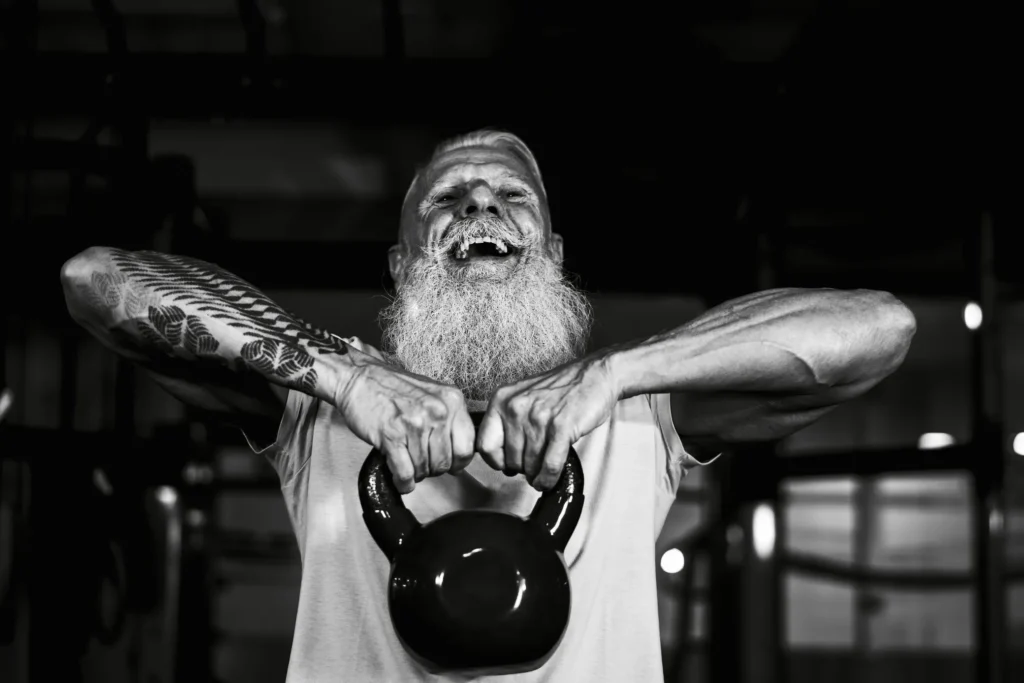
Within those patterns, The Sisu Seven are the loaded movements every member learns: Kettlebell Swing, Kettlebell Snatch, Goblet Squat, Turkish Get-Up, Farmer Carry, Kettlebell Press, Dead Hang. The principle is mastery, not variety. A member who masters the Sisu Seven can train at home with two kettlebells and stay strong for life.
The measurement system is the second half of what makes the cohort a training program rather than a class. Every member completes the Sisu Assessment at enrollment and again every six months. Eight tests cover cardiovascular reserve, strength, balance, gait, body composition, foot health, and movement quality. The result is a Strongest Decade Outlook: On Track, Building, or Act Now. The thresholds are drawn from peer-reviewed mortality and morbidity research (Mandsager et al., 2018; Studenski et al., 2011; Bohannon, 2019; Araujo et al., 2022), not from gym benchmarks.
A faster Demotu movement screen runs every four to six weeks, producing updated movement scores and corrective programming. Biomarkers move slowly. Movement quality changes faster. Both loops drive the cohort programming.
What Makes Sisu’s Cohort Different
A few details set the cohort program apart from a personal training package or a group class membership.
Small group with continuity. Four members maximum. The same four people across the full sixteen weeks. The coach learns each member’s story, their assessment data, their movement patterns, and their progression. Drop-in classes can’t do this.
Assessment-driven programming. The Sisu Assessment and the Demotu screen produce specific, individualized targets for every member. The session template is shared. The scaling within each exercise slot is personal. A 55-year-old new member and a 35-year-old experienced member do the same session, different loads, different regressions. The MBSC model proven at scale.
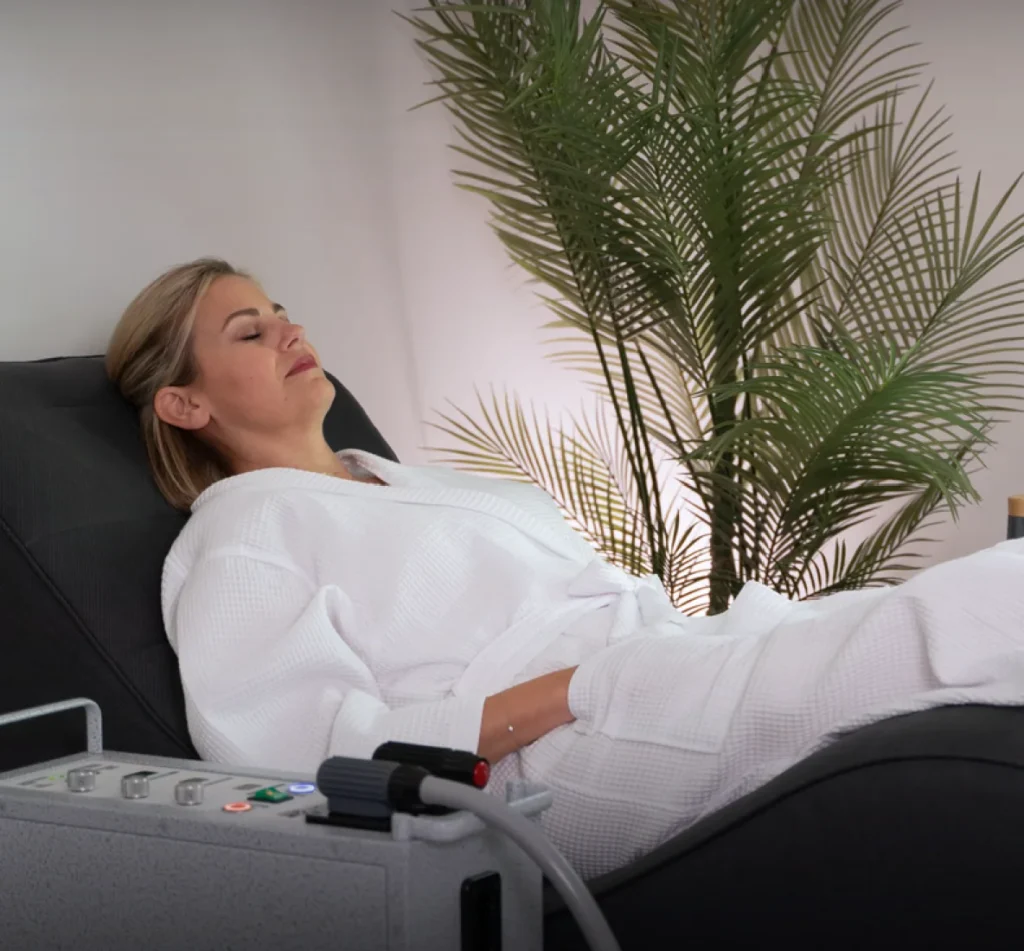
Recovery included by design. The Ritual is part of the membership, not an upsell. The session is not done when the lifting is done. The session is done when the sauna is done. The recovery is structured, protocol-matched to what was trained, and shared with the cohort.
Measurement loop with proof. VO2 max, grip strength, body composition, movement quality, gait speed. Numbers on paper at the start of the cycle and numbers on paper sixteen weeks later. The system is built to produce evidence that the training is working. If it isn’t working for a member, the data shows that and the programming changes.
Founder-led, evidence-based. Sisu Longevity Studio is veteran-owned. The cohort programming, the assessment protocol, and the recovery integration were built from the published research and from Mike Boyle’s adult-member functional training body of work, not from fitness-industry fashion.
Experience the Sisu Cohort
Three ways to begin:
- Schedule a free tour: see the studio, meet the team, no commitment.
- Explore membership tiers: pricing, packs, and how the cohort fits into the Sisu approach.
- Book your Sisu Assessment: the eight-test baseline that informs your cohort placement and programming.
References
- Araujo, C. G., de Souza E Silva, C. G., Laukkanen, J. A., Singh, M. F., Kunutsor, S. K., Myers, J., Franca, J. F., & Castro, C. L. B. (2022). Successful 10-second one-legged stance performance predicts survival in middle-aged and older individuals. British Journal of Sports Medicine, 56(17), 975-980. DOI: 10.1136/bjsports-2021-105360
- Bohannon, R. W. (2019). Grip Strength: An Indispensable Biomarker For Older Adults. Clinical Interventions in Aging, 14, 1681-1691. DOI: 10.2147/CIA.S194543
- Cruz-Jentoft, A. J., Bahat, G., Bauer, J., Boirie, Y., Bruyère, O., Cederholm, T., Cooper, C., Landi, F., Rolland, Y., Sayer, A. A., Schneider, S. M., Sieber, C. C., Topinkova, E., Vandewoude, M., Visser, M., Zamboni, M., & Writing Group for the European Working Group on Sarcopenia in Older People 2 (EWGSOP2). (2019). Sarcopenia: revised European consensus on definition and diagnosis. Age and Ageing, 48(1), 16-31. DOI: 10.1093/ageing/afy169
- Mandsager, K., Harb, S., Cremer, P., Phelan, D., Nissen, S. E., & Jaber, W. (2018). Association of Cardiorespiratory Fitness With Long-term Mortality Among Adults Undergoing Exercise Treadmill Testing. JAMA Network Open, 1(6), e183605. DOI: 10.1001/jamanetworkopen.2018.3605
- Studenski, S., Perera, S., Patel, K., Rosano, C., Faulkner, K., Inzitari, M., Brach, J., Chandler, J., Cawthon, P., Connor, E. B., Nevitt, M., Visser, M., Kritchevsky, S., Badinelli, S., Harris, T., Newman, A. B., Cauley, J., Ferrucci, L., & Guralnik, J. (2011). Gait speed and survival in older adults. JAMA, 305(1), 50-58. DOI: 10.1001/jama.2010.1923
- Boyle, M. (2016). New Functional Training for Sports (2nd ed.). Human Kinetics.
- Clark, M. A., Lucett, S. C., & Sutton, B. G. (Eds.). (2014). NASM Essentials of Corrective Exercise Training. Jones & Bartlett Learning.
Sisu Longevity Studio | 10855 Hidden Pool Heights, Suite 140 | Colorado Springs, CO 80908