
By Thom Salo, COL, USA (Ret), NASM CPT, 5x Ironman, Longevity Director Updated September 9, 2026
Red light therapy gets used as a blanket term for everything from at-home masks to medical-grade panels. The science is more specific than the marketing tends to suggest. The short version: red and near-infrared wavelengths at therapeutic doses act directly on mitochondria, increasing cellular energy production and modulating inflammation. Done right, it improves muscle performance and recovery, supports skin and wound healing, and has emerging evidence for brain and mental-health applications. This guide covers what the research shows, how to use it, and where the claims still outrun the data.
What is red light therapy?
Red light therapy, more formally photobiomodulation (PBM) or low-level light therapy (LLLT), uses red and near-infrared light in the 600 to 1100 nanometer range delivered through laser diodes or light-emitting diodes (LEDs). At therapeutic dose levels the light is non-thermal and FDA-cleared as an insignificant-risk device for general wellness use. The light reaches skin and underlying tissue, penetrating several centimeters in the case of near-infrared wavelengths.
The primary site of light absorption is cytochrome c oxidase, an enzyme in the mitochondrial respiratory chain. Light absorption at this site releases inhibitory nitric oxide, restores electron transport, and increases ATP production (de Freitas & Hamblin, 2016; Hamblin, 2018). Downstream effects include reduced oxidative stress in stressed cells, modulation of inflammatory pathways, and activation of transcription factors that drive protein synthesis, cell migration, and repair (Hamblin, 2017).
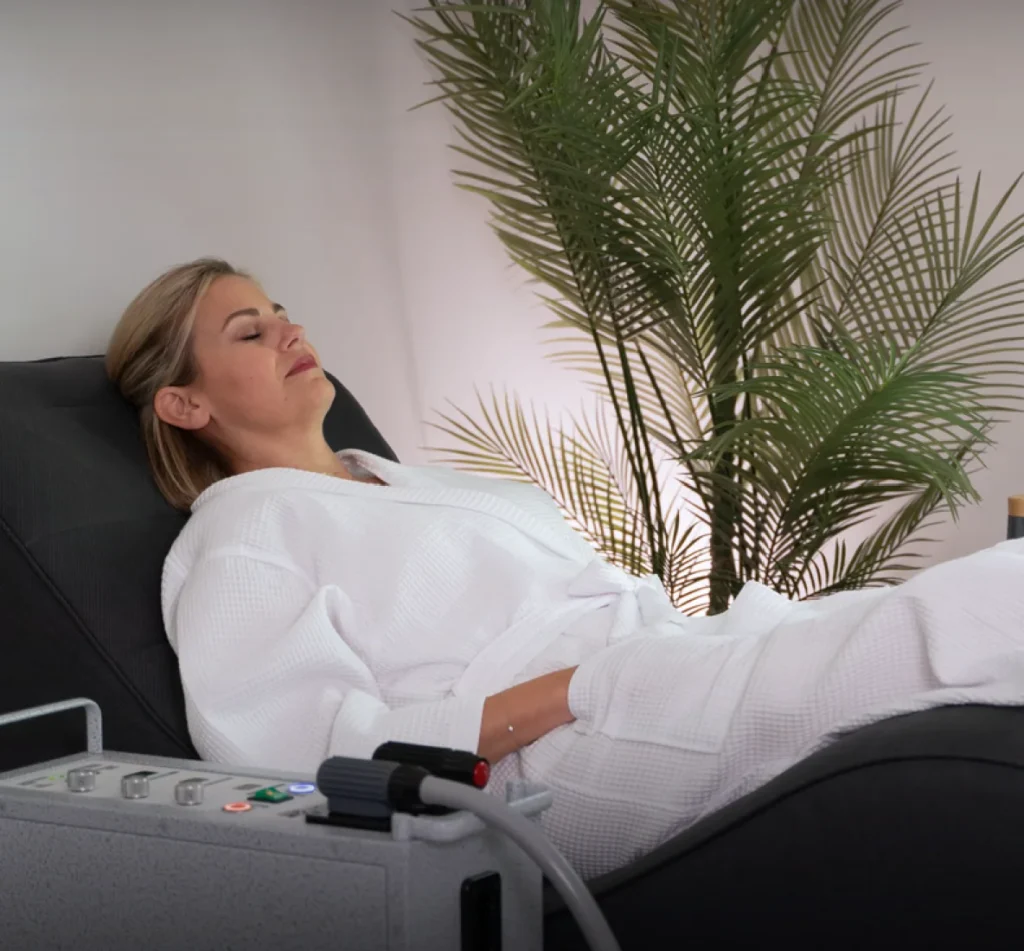
At Sisu Longevity Studio, we use the Regenesis ExoRed system, a medical-grade full-body red light bed. You lay in the bed for 10 to 20 minutes per session, with the lights surrounding your full body for direct exposure top to bottom. No special clothing required, though more skin exposure means more direct dose.
What the research shows
Photobiomodulation is supported by a substantial body of peer-reviewed research. The mechanism is mapped at the molecular level, and multiple meta-analyses have tested it in human exercise and clinical contexts.
Muscle performance and recovery. A 2015 systematic review and meta-analysis covering 13 randomized controlled trials concluded that phototherapy improves muscular performance and accelerates recovery, particularly when applied before exercise. Time to exhaustion increased by an average of 4.12 seconds versus placebo, and number of repetitions increased by 5.47 (Leal-Junior et al., 2015). A larger 2017 follow-up meta-analysis covering 39 trials and 861 participants reached similar conclusions across both LLLT and LED therapy, with strongest effects at wavelengths between 655 and 950 nm (Vanin et al., 2017). A 2022 mode-specific meta-analysis confirmed PBM improves muscle endurance performance in single-joint exercises and time-to-exhaustion performance in cycling, but found no effect on muscle strength or on running and swimming performance metrics (Dutra et al., 2022). A 2016 review specifically on PBM in human muscle tissue for sports performance reached the same conclusion: PBM increases muscle mass gained after training and decreases inflammation and oxidative stress in muscle biopsies (Ferraresi et al., 2016).
Anti-inflammatory effects. One of the most reproducible effects of PBM is an overall reduction in inflammation. Mechanism studies have shown PBM reduces markers of M1-phenotype inflammatory macrophages, lowers prostaglandins, and reduces reactive nitrogen species in numerous animal models. The effect has been documented in joint disorders, traumatic injuries, lung disorders, and the brain (Hamblin, 2017).
Brain and cognitive function. A 2014 open-protocol pilot study at the VA Boston Healthcare System applied transcranial red and near-infrared LED to 11 patients with chronic mild traumatic brain injury. After 18 sessions over 6 weeks, participants showed statistically significant improvements on executive function tests, verbal learning, and long-delay recall. Participants and family reported better sleep, fewer PTSD symptoms where present, and improved social, interpersonal, and occupational functioning (Naeser et al., 2014). This is pilot-stage evidence, not definitive proof, but it is meaningful enough that the same VA team has been pursuing placebo-controlled follow-up studies.
The peer-reviewed picture for skin, wound healing, hair growth, depression, and several other applications is also developing, with varying strength of evidence. The strongest claims at this point are for muscle recovery, anti-inflammatory effects, and tissue repair. Other applications are promising but less settled.
How it works
Mitochondrial activation. The primary mechanism. Red and near-infrared light is absorbed by cytochrome c oxidase, the fourth enzyme in the mitochondrial electron transport chain. Light absorption dissociates inhibitory nitric oxide from the enzyme, restoring full electron flow and increasing ATP production (de Freitas & Hamblin, 2016). More ATP means more cellular energy available for repair, protein synthesis, and adaptation.
Anti-inflammatory signaling. PBM activates transcription factors that down-regulate pro-inflammatory pathways while up-regulating antioxidant defenses. The effect is biphasic: stressed cells show reduced inflammatory markers, while quiescent cells may show transient activation of similar pathways. Net result in injured or training-stressed tissue is reduced inflammation and faster resolution (Hamblin, 2017; Hamblin, 2018).
Circulation and tissue repair. Local nitric oxide release after PBM increases blood flow at the treatment site, accelerating nutrient delivery and waste clearance. Combined with the ATP and anti-inflammatory effects, this creates conditions for faster tissue repair, which is why PBM shows up in protocols for wound healing, post-surgical recovery, and post-training muscle recovery.
Quick-reference decision table
| Why are you using red light therapy? | Session length | Frequency | What to expect |
| Muscle endurance pre-workout | 10 to 15 min | Before the session. Anywhere from immediately prior to about 2 hours ahead. | More reps and later fatigue. Not a max-strength effect. |
| Muscle recovery post-workout | 10 to 20 min | Within a few hours of training | Less soreness, faster return to baseline |
| Skin health | 10 to 15 min | 3 to 5 sessions per week, 8 to 12 weeks | Gradual improvement in tone and texture |
| Chronic joint pain or tendinopathy | 10 to 20 min | 3 to 5 sessions per week, 4 to 8 weeks | Reduced pain and stiffness over weeks |
| General longevity and recovery | 10 to 20 min | 2 to 3 sessions per week | Cumulative benefit, no single-session effect |
| First visit / curious | 10 min | One session, see how you feel | Warmth on the skin, no sensation otherwise |
What a session feels like
A red light session is quiet and uneventful. You lay in the Regenesis ExoRed bed, the lights surround your body, and the session runs for 10 to 20 minutes. You feel mild warmth on the skin, no more. No sound, no sensation in deeper tissue. You can close your eyes, listen to music, or rest.
After the session, the effects build over hours to days. There’s no immediate dramatic shift the way a sauna or cold plunge produces. Members who use red light consistently for several weeks often notice the cumulative effect: better sleep on training days, faster recovery between hard sessions, modest improvements in skin texture, reduced background joint pain. The mechanism is cellular and the effect compounds.
Frequency and dose-response
The peer-reviewed protocols that have shown effect use a range of doses:
- Pre-workout muscle endurance: 5 to 6 joules per point, wavelengths 655 to 950 nm (Leal-Junior et al., 2015; Vanin et al., 2017).
- Post-workout recovery: similar dosing, applied within a few hours after the session.
- Skin and tissue repair: 3 to 5 sessions per week for 8 to 12 weeks, then maintenance.
- Chronic pain / inflammation: 3 to 5 sessions per week for 4 to 8 weeks, then assess.
On timing. The evidence supports applying red light before exercise rather than after. In a 12-week randomized, double-blinded, placebo-controlled trial, only the group treated before training sessions showed significant gains in peak torque and 1-repetition maximum; treating after training, or both before and after, did not produce the same effect (Vanin et al., 2016). One exposure on the front end is what the data supports, and doubling up did not help.
What has not been established is an optimal interval. No human trial has compared one pre-exercise timing against another, so any specific “X minutes before” figure is convention rather than a finding. The mechanistic picture suggests the window is wide: in intact skeletal muscle, cytochrome c oxidase activity was elevated at 5 minutes, 10 minutes, 30 minutes, and at 1, 2, 12, and 24 hours after irradiation (Albuquerque-Pontes et al., 2014). That is animal data, so hold it loosely, but it points the same direction as the human trials, which applied light anywhere from a few minutes to about an hour beforehand and still showed effect. Practically: anywhere from immediately before to roughly two hours prior is consistent with the protocols that have worked. There is no evidence that a short gap is too short.
On what to expect. The benefit is specific. The mode-specific meta-analysis found improvements in single-joint muscle endurance and in cycling time to exhaustion, with small effect sizes, and no effect on muscle strength, on running performance, or on swimming performance (Dutra et al., 2022). Red light before a session is a reps-and-time-to-exhaustion tool, not a way to move a one-rep max on the day.
There’s a pronounced biphasic dose-response curve in PBM: low to moderate doses produce stimulation and benefit, while very high doses can become inhibitory (Hamblin, 2017). More is not better past the therapeutic window. The Regenesis ExoRed system at Sisu is calibrated to deliver effective doses within the therapeutic range. Standard 10 to 20 minute sessions land in the right zone.
Combining red light therapy with other modalities
Red light sequences well with most of the modalities on the Sisu floor:
- Red light + sauna (same visit). Red light first, sauna second. The PBM pre-conditioning supports mitochondrial readiness for the thermal challenge.
- Red light + cold plunge (same visit). Red light first, cold second. Cold after PBM helps consolidate the anti-inflammatory effect.
- Red light + float therapy. Different visits work fine. Red light is brief and active; float is long and passive. They serve different recovery purposes.
- Red light + HBOT. Both work on mitochondrial function through different mechanisms. Either order is fine within the same visit.
- Red light + Training Lab cohort session. Use it before the session. In a 12-week controlled trial, the group that received phototherapy before training gained significantly more strength than the groups that received it after training, or both before and after (Vanin et al., 2016). One exposure on the front end is the pattern the evidence supports.
A red light session at Sisu
Red light therapy at Sisu is a solo modality. The Regenesis ExoRed bed serves one person at a time. You book a 15 to 20 minute window, change into whatever leaves the skin exposed that you’re comfortable with, and run the session yourself once a Longevity Technician has walked you through the setup.
A few things worth knowing:
- A Longevity Technician walks you through the bed, the timer, and the controls on your first visit.
- More skin exposure means more direct dose. Members who are working on a specific area can position to target it directly; members using it for general recovery get full-body exposure as designed.
- Eye protection is optional but provided. The light is bright. Most members close their eyes or wear the goggles.
Experience Red Light Therapy at Sisu
Three ways to begin:
- Schedule a free tour: see the studio, meet the team, no commitment.
- Explore membership tiers: pricing, packs, and how red light therapy fits into the Sisu approach.
- Book a single session: drop in and try it.
Related modalities at Sisu
- Contrast therapy: thermal stress and autonomic training through alternating sauna and cold plunge.
- HBOT (hyperbaric oxygen therapy): complementary mitochondrial pathway through oxygen enrichment and pressurization.
- Float therapy: nervous system recovery through sensory reduction.
- Compression therapy: circulation-driven recovery for legs and lower body.
Live Better … Longer.
References
- Albuquerque-Pontes, G. M., Vieira, R. P., Tomazoni, S. S., Caires, C. O., Nemeth, V., Vanin, A. A., Santos, L. A., Pinto, H. D., Marcos, R. L., Bjordal, J. M., de Carvalho, P. T. C., & Leal-Junior, E. C. P. (2015). Effect of pre-irradiation with different doses, wavelengths, and application intervals of low-level laser therapy on cytochrome c oxidase activity in intact skeletal muscle of rats. Lasers in Medical Science, 30(1), 59-66. DOI: 10.1007/s10103-014-1616-2
- de Freitas, L. F., & Hamblin, M. R. (2016). Proposed mechanisms of photobiomodulation or low-level light therapy. IEEE Journal of Selected Topics in Quantum Electronics, 22(3), 7000417. DOI: 10.1109/JSTQE.2016.2561201
- Dutra, Y. M., Malta, E. S., Elias, A. S., Broatch, J. R., & Zagatto, A. M. (2022). Deconstructing the ergogenic effects of photobiomodulation: A systematic review and meta-analysis of its efficacy in improving mode-specific exercise performance in humans. Sports Medicine, 52(11), 2733-2757. DOI: 10.1007/s40279-022-01714-y
- Ferraresi, C., Huang, Y. Y., & Hamblin, M. R. (2016). Photobiomodulation in human muscle tissue: an advantage in sports performance? Journal of Biophotonics, 9(11-12), 1273-1299. DOI: 10.1002/jbio.201600176
- Hamblin, M. R. (2017). Mechanisms and applications of the anti-inflammatory effects of photobiomodulation. AIMS Biophysics, 4(3), 337-361. DOI: 10.3934/biophy.2017.3.337
- Hamblin, M. R. (2018). Mechanisms and mitochondrial redox signaling in photobiomodulation. Photochemistry and Photobiology, 94(2), 199-212. DOI: 10.1111/php.12864
- Leal-Junior, E. C., Vanin, A. A., Miranda, E. F., de Carvalho, P. T., Dal Corso, S., & Bjordal, J. M. (2015). Effect of phototherapy (low-level laser therapy and light-emitting diode therapy) on exercise performance and markers of exercise recovery: a systematic review with meta-analysis. Lasers in Medical Science, 30(2), 925-939. DOI: 10.1007/s10103-013-1465-4
- Naeser, M. A., Zafonte, R., Krengel, M. H., Martin, P. I., Frazier, J., Hamblin, M. R., Knight, J. A., Meehan, W. P., & Baker, E. H. (2014). Significant improvements in cognitive performance post-transcranial, red/near-infrared light-emitting diode treatments in chronic, mild traumatic brain injury: open-protocol study. Journal of Neurotrauma, 31(11), 1008-1017. DOI: 10.1089/neu.2013.3244
- Vanin, A. A., Miranda, E. F., Machado, C. S. M., de Paiva, P. R. V., Albuquerque-Pontes, G. M., Casalechi, H. L., de Carvalho, P. T. C., & Leal-Junior, E. C. P. (2016). What is the best moment to apply phototherapy when associated to a strength training program? A randomized, double-blinded, placebo-controlled trial. Lasers in Medical Science, 31(8), 1555-1564. DOI: 10.1007/s10103-016-2015-7
- Vanin, A. A., Verhagen, E., Barboza, S. D., Costa, L. O. P., & Leal-Junior, E. C. P. (2017). Photobiomodulation therapy for the improvement of muscular performance and reduction of muscular fatigue associated with exercise in healthy people: a systematic review and meta-analysis. Lasers in Medical Science, 33(1), 181-214. DOI: 10.1007/s10103-017-2368-6