
By Thom Salo, COL, USA (Ret), NASM CPT, 5x Ironman, Longevity Director Updated July 21, 2026
If you’ve trained hard for a long stretch, served in a high-vigilance role, traveled at altitude, or just lived a noisy modern life, your nervous system is probably running with more sympathetic tone than it should. Float therapy is one of the few interventions that can change that in under an hour. The short answer: a float session reduces the sensory inputs that keep your nervous system busy, and your body uses the time to do what it cannot do while your senses are working. This guide explains the mechanism, the research, and how to use float therapy for what you’re actually trying to accomplish.
What is float therapy?
Float therapy, formally Floatation-REST (Reduced Environmental Stimulation Therapy), places you in approximately 10 inches of body-temperature water saturated with about 1,000 pounds of Epsom salt. The salt makes you effortlessly buoyant. The tank or room is dark, sound-attenuated, and held at skin temperature (typically 93 to 95°F) so the boundary between water and air becomes hard to detect.
Within the first 15 to 20 minutes of a session, the brain stops receiving meaningful input from the visual, auditory, thermal, tactile, gravitational, and proprioceptive channels (Feinstein et al., 2018). Heart rate and blood pressure drop. Breathing slows. The autonomic nervous system shifts toward parasympathetic dominance (Flux et al., 2022). At some point in most sessions, members report a sensation that the edges of their body become hard to locate, an experience that research has linked to the reduction in anxiety the therapy produces (Hruby et al., 2024).
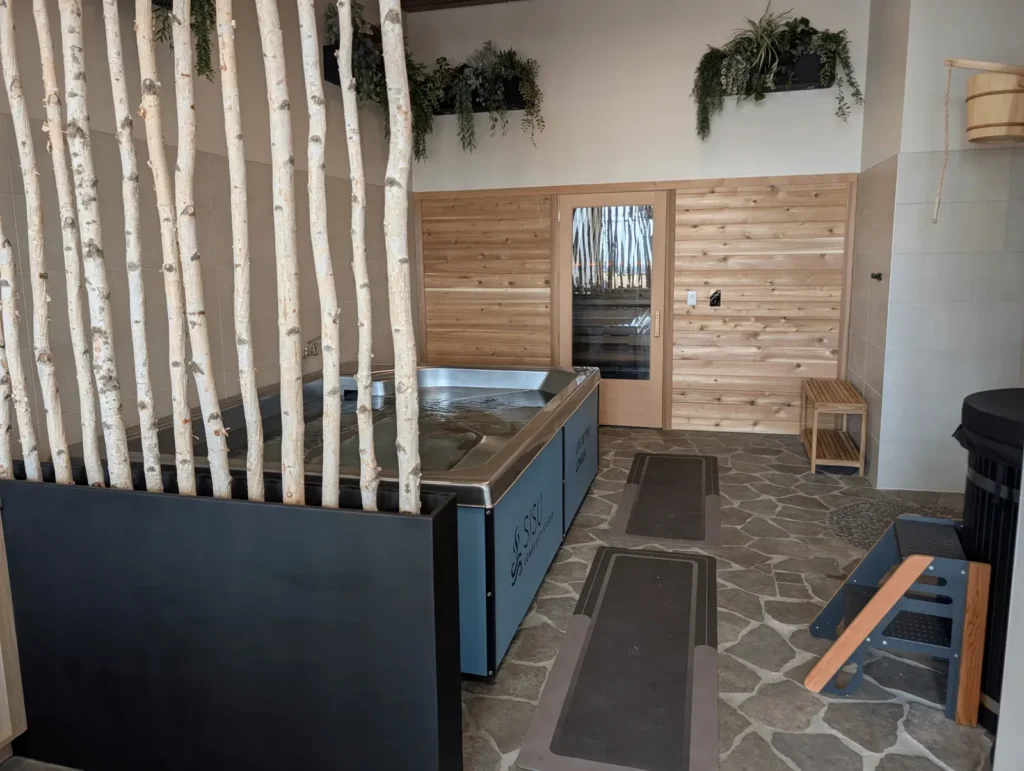
At Sisu Longevity Studio, our float space is a Royal Spa open-design float room: a single private suite with a walk-in shower, a two-person-capacity tank, and full member control over lighting, music, and door open or closed throughout the session. The two-person capacity is intentional. Couples Float is a single booking in a single tank, and it is one of the most-requested first sessions for partners new to the studio.
The mechanism: four systems, one input change
Float therapy works because almost every system in the body responds when its sensory input drops. Four pathways are well-documented in peer-reviewed research.
The autonomic nervous system shifts toward rest. When sensory input drops, sympathetic activity decreases. In a within-subjects crossover study, Floatation-REST produced significant decreases in systolic and diastolic blood pressure, breathing rate, and HRV indices that reflect sympathetic activity, alongside an increase in normalized high-frequency HRV, the marker of parasympathetic activity (Flux et al., 2022). The shift held across both anxious and non-anxious participants. The change is not dependent on diagnosis or expectation.
The brain quiets the default-mode network. Functional MRI work has shown that after a 90-minute float, resting-state functional connectivity decreases within the default-mode network (the brain’s “self-referential” hub) and between the default-mode network and somatomotor cortex (Al Zoubi et al., 2021). In plain terms, the parts of your brain that build the running narrative of “you doing things, you thinking about things, you noticing your body” become less active. This appears to be the neural correlate of what members describe as the body-boundary dissolution experience (Hruby et al., 2024).
Stress, anxiety, and muscle tension drop. Multiple controlled trials have documented significant reductions in subjective stress, anxiety, depression, and pain following both single sessions and multi-session protocols (Kjellgren et al., 2001; Bood et al., 2009; Kjellgren & Westman, 2014; Jonsson & Kjellgren, 2016). In an open-label clinical study with 50 anxious and depressed participants, a single float session produced state anxiety reductions with Cohen’s d greater than 2, an unusually large effect for a single behavioral intervention (Feinstein et al., 2018). Feasibility work in clinical populations including anorexia nervosa has shown the intervention is safe and well-tolerated across body-image-sensitive groups (Khalsa et al., 2020).
Lactate clearance and recovery accelerate. For physically active members, a 60-minute float after high-intensity eccentric exercise produced significantly greater blood lactate clearance and lower perceived pain than passive recovery, though muscle strength and 24- and 48-hour muscle soreness were not different (Morgan et al., 2013). The recovery effect is consistent with the autonomic and circulatory mechanisms: reduced sympathetic tone, improved venous return through buoyancy, and removal of the gravitational load on the musculoskeletal system create conditions for faster waste clearance.
Quick-reference decision table
| Why are you floating? | Session length | Frequency | What to expect |
| Nervous system reset / stress recovery | 60 to 90 min | 1 to 2 per week initially | Anxiety drop lasting 48+ hours |
| Post-workout recovery (endurance or strength) | 60 min | Within 2 to 6 hours post-training | Faster lactate clearance, lower perceived soreness |
| Sleep difficulty | 60 to 90 min | 2 per week for 4 to 6 weeks | Improved sleep onset, especially in younger adults |
| Pain and muscle tension | 60 to 90 min | 12-session arc over 6 to 8 weeks | Sustained reductions documented in clinical trials |
| First visit or curious | 60 min | One session, see how you feel | Most people fall somewhere between deeply relaxed and falling asleep |
The Epsom salt physics
The float solution contains approximately 1,000 pounds of magnesium sulfate (Epsom salt) dissolved in 180 to 200 gallons of water. This creates a specific gravity around 1.25, denser than the Dead Sea, which is what makes floating effortless. You do not need to balance, kick, or work to stay at the surface. The water finds its own level under you.
Members commonly report deeper sleep on the night of a float. The most likely mechanism is the parasympathetic shift documented in the cardiovascular and brain-imaging research above. Claims that Epsom salt baths deliver meaningful transdermal magnesium are common in marketing but not well-supported in peer-reviewed research, so we do not lean on that claim.
What a session feels like
Your first 60 to 90 minutes in the tank rarely look the same as your fifth. The general arc:
Minutes 0 to 10. Settling in. You notice the temperature, the position of your head, the small sound of your breathing. You may briefly itch, adjust, find a more comfortable position for your arms.
Minutes 10 to 25. The transition. Heart rate and breathing slow. Sensory adaptation builds. Some members fall asleep here. Others move into a state that is harder to describe, often called “between awake and asleep.”
Minutes 25 to 60. The float proper. This is where the parasympathetic shift consolidates and where the brain’s default-mode network quiets (Al Zoubi et al., 2021). Time perception changes. Many members are surprised by how much time has passed when the session ends.
Minutes 60 to 90 (longer sessions). The deepest part of the session. The body-boundary dissolution that mediates the anxiolytic effect tends to occur here in longer sessions (Hruby et al., 2024).
Music, dim light, or full sensory reduction are all options under member control. Most people find that full reduction produces the strongest effect after the first or second session, once the novelty of the environment is past.
Frequency and dose-response
The research-supported frequency for sustained benefits:
- Acute stress or anxiety relief: single sessions produce measurable effects lasting at least 48 hours (Garland et al., 2023).
- Generalized anxiety reduction: a 12-session protocol has produced clinically significant change in trial populations, with 37 percent of GAD participants reaching full remission and most improvements maintained at 6-month follow-up (Jonsson & Kjellgren, 2016).
- Chronic stress-related pain: a 12-session protocol over 7 weeks has produced significant reductions in pain, anxiety, depression, and improvements in sleep quality (Bood et al., 2009; Kjellgren & Westman, 2014).
- Insomnia: a single-case experimental design study of 12 sessions found preliminary improvements in sleep-onset and sleep efficiency, with the largest gains in younger adults; the sample was small and the findings warrant replication (Norell-Clarke et al., 2022).
For most members, a baseline of two sessions per month is enough to maintain the nervous-system reset benefit. Members managing higher stress loads, recovering from heavy training, or working on a specific issue often run weekly for an initial 8 to 12 weeks and then taper.
Combining float therapy with other modalities
Floating sequences well with the other modalities on the floor:
- Float + sauna (same visit). Sauna first, then float. The thermal load of sauna primes the parasympathetic shift. Floating immediately after extends and deepens it.
- Float + cold plunge (same visit). Float first, then cold plunge if you are in for a session ending on cold. Or sauna, cold, float as a long arc when time allows.
- Float + mHBOT (different days). Both produce parasympathetic shifts through different mechanisms. Stacking them in the same week is reasonable but on different days, since the experience of each benefits from being undisturbed.
- Float + Training Lab cohort session. A weekly or biweekly float pairs cleanly with cohort programming. Floating after a strength-dominant day is fine. Cold is the modality that has training-day timing constraints. Float does not.
A float session at Sisu
The float room at Sisu is a single private suite. You shower, you float, you shower again, you decompress in the lounge. There is no group component to a float, the way contrast therapy has The Ritual after a cohort training session. Float is a solo modality, with Couples Float as the one exception.
A few things worth knowing before your first session:
- A Longevity Technician walks you through the room on your first visit, including how the door, light, and music controls work, and how to exit if you want to. After that, you run your own session.
- The shower before and after is part of the protocol. Before, to remove oils, lotions, and contaminants. After, to rinse the salt.
- For Training Lab cohort members, your Coach can advise on when to add a float to your training week. Float pairs cleanly with both strength and endurance days, unlike cold plunge, which has training-day timing constraints.
The Couples Float option is one of the more common first-visit formats at Sisu. The tank is two-person capacity, the booking is a single session, the experience is shared. Sisu Forever lifetime members bring a +1 guest free on every float session.
Experience Float Therapy at Sisu
Three ways to begin:
- Schedule a free tour: see the studio, meet the team, no commitment.
- Explore membership tiers: pricing, packs, and how float therapy fits into the Sisu approach.
- Book a single session: drop in and try it.
Related modalities at Sisu
- Contrast therapy: thermal stress and autonomic training through alternating sauna and cold plunge.
- mHBOT (mild hyperbaric oxygen therapy): a different parasympathetic and recovery pathway through oxygen enrichment and pressurization.
- Halotherapy: dry salt aerosol for respiratory recovery, often used in combination with float for nervous system days.
- Red light therapy: cellular-level recovery through photobiomodulation.
Sisu Forever lifetime members bring +1 guest free on every float session.
Live Better … Longer.
References
- Al Zoubi, O., Misaki, M., Bodurka, J., Kuplicki, R., Wohlrab, C., Schoenhals, W. A., Refai, H. H., Khalsa, S. S., Stein, M. B., Paulus, M. P., & Feinstein, J. S. (2021). Taking the body off the mind: Decreased functional connectivity between somatomotor and default-mode networks following Floatation-REST. Human Brain Mapping, 42(10), 3216-3227. DOI: 10.1002/hbm.25429
- Bood, S. A., Kjellgren, A., & Norlander, T. (2009). Treating stress-related pain with the flotation restricted environmental stimulation technique: Are there differences between women and men? Pain Research & Management, 14(4), 293-298. DOI: 10.1155/2009/298935
- Feinstein, J. S., Khalsa, S. S., Yeh, H. W., Wohlrab, C., Simmons, W. K., Stein, M. B., & Paulus, M. P. (2018). Examining the short-term anxiolytic and antidepressant effect of Floatation-REST. PLoS ONE, 13(2), e0190292. DOI: 10.1371/journal.pone.0190292
- Flux, M. C., Fine, T. H., Poplin, T., Al Zoubi, O., Schoenhals, W. A., Schettler, J., Refai, H. H., Naegele, J., Wohlrab, C., Yeh, H. W., Lowry, C. A., Levine, J. C., Smith, R., Khalsa, S. S., & Feinstein, J. S. (2022). Exploring the acute cardiovascular effects of Floatation-REST. Frontiers in Neuroscience, 16, 995594. DOI: 10.3389/fnins.2022.995594
- Garland, M. M., Wilson, R., Adamic, E., Thompson, W. K., Arevian, A. C., Stein, M. B., Paulus, M. P., Feinstein, J. S., & Khalsa, S. S. (2023). Reduced Environmental Stimulation Therapy (REST) in anxiety and depression: An experience sampling study. Journal of Mood and Anxiety Disorders, 1, 100003. DOI: 10.1016/j.xjmad.2023.100003
- Hruby, H., Schmidt, S., Feinstein, J. S., & Wittmann, M. (2024). Induction of altered states of consciousness during Floatation-REST is associated with the dissolution of body boundaries and the distortion of subjective time. Scientific Reports, 14(1), 9316. DOI: 10.1038/s41598-024-59642-y
- Jonsson, K., & Kjellgren, A. (2016). Promising effects of treatment with flotation-REST (restricted environmental stimulation technique) as an intervention for generalized anxiety disorder (GAD): A randomized controlled pilot trial. BMC Complementary and Alternative Medicine, 16, 108. DOI: 10.1186/s12906-016-1089-x
- Kjellgren, A., Sundequist, U., Norlander, T., & Archer, T. (2001). Effects of flotation-REST on muscle tension pain. Pain Research & Management, 6(4), 181-189. DOI: 10.1155/2001/768501
- Kjellgren, A., & Westman, J. (2014). Beneficial effects of treatment with sensory isolation in flotation-tank as a preventive health-care intervention: A randomized controlled pilot trial. BMC Complementary and Alternative Medicine, 14, 417. DOI: 10.1186/1472-6882-14-417
- Khalsa, S. S., Moseman, S. E., Yeh, H. W., Upshaw, V., Persac, B., Breese, E., Lapidus, R. C., Chappelle, S., Paulus, M. P., & Feinstein, J. S. (2020). Reduced Environmental Stimulation in Anorexia Nervosa: An early-phase clinical trial. Frontiers in Psychology, 11, 567499. DOI: 10.3389/fpsyg.2020.567499
- Morgan, P. M., Salacinski, A. J., & Stults-Kolehmainen, M. A. (2013). The acute effects of flotation restricted environmental stimulation technique on recovery from maximal eccentric exercise. Journal of Strength and Conditioning Research, 27(12), 3467-3474. DOI: 10.1519/JSC.0b013e31828f277e
- Norell-Clarke, A., Jonsson, K., Blomquist, A., Ahlzén, R., & Kjellgren, A. (2022). A study of flotation-REST (restricted environmental stimulation therapy) as an insomnia treatment. Sleep Science, 15(Spec 2), 361-368. DOI: 10.5935/1984-0063.20210012