
By Thom Salo, COL USA (Ret), NASM CPT, 5x Ironman, Longevity Director Updated May 11, 2026
Sisu offers hyperbaric oxygen therapy, or HBOT, as one of the premium recovery modalities at the studio. It is also the modality members ask the most questions about, partly because the science is real and partly because the wellness market has flooded the term with claims that range from defensible to ridiculous.
What is HBOT?
Hyperbaric oxygen therapy is the use of pressurized oxygen, delivered above normal atmospheric pressure, to increase the amount of oxygen that dissolves into the blood and tissues. Wellness hyperbaric oxygen therapy refers to lower pressures than the clinical-grade HBOT used in hospitals for specific medical conditions, typically delivered in a wellness setting and not requiring a prescription.
Atmospheric pressure at sea level is 1.0 ATA (atmospheres absolute). Inside a wellness HBOT chamber, pressure is increased to between 1.3 and 2.0 ATA. The user breathes either ambient chamber air, a higher oxygen concentration delivered through a mask, or, in the most capable systems, near-pure oxygen at chamber pressure.
The result is a measurable, non-trivial increase in the amount of oxygen reaching the body’s tissues. Hemoglobin in red blood cells is already nearly saturated at sea level, so the additional oxygen rides primarily in the blood plasma. That plasma-dissolved oxygen reaches the tissues that hemoglobin alone cannot supply efficiently, including injured or inflamed tissue with restricted circulation.
That is the entire mechanism, more or less. Pressure plus oxygen equals more oxygen at the cellular level. What that does in the body, and for whom, is where the conversation gets interesting.
The Science: What Oxygen Under Pressure Does
Three biological processes are well-documented in the hyperbaric oxygen literature.
Tissue oxygenation. Pressurized oxygen drives oxygen into tissues with restricted blood flow, including injured or inflamed tissue. This is why HBOT has a long-established clinical use in wound healing.
Anti-inflammatory and immune effects. Sustained sessions reduce certain inflammatory markers and modulate immune cell activity. The mechanism connects to oxidative signaling pathways the body uses to manage repair.
Stem cell and tissue regeneration support. A growing literature documents increased circulating stem cells and improved tissue repair markers following HBOT protocols, particularly in the context of brain injury, cardiac recovery, and aging-related cellular changes (Hachmo et al., 2020).
The Hachmo group at Tel Aviv University published a notable 2020 trial in Aging showing that 60 daily HBOT sessions in healthy adults aged 64 and older produced measurable lengthening of telomeres (the protective caps on chromosomes that shorten with age) and reduced the population of senescent cells (cells that have stopped dividing but persist in tissue and contribute to aging). The trial used a clinical HBOT protocol (2.0 ATA, 100 percent oxygen, 90-minute sessions). The findings reset what is plausibly possible for hyperbaric therapy as a longevity intervention rather than a treatment for acute injury.
Wellness HBOT vs HBOT: The Transferability Question
Most of the published research uses clinical-grade HBOT, typically at 2.0 ATA or higher with high-concentration oxygen, in hospital chambers. The wellness-market HBOT segment usually operates at 1.3 to 1.5 ATA in soft-shell chambers without supplemental oxygen. Honest readers ask the right question: does the HBOT research actually apply to wellness HBOT?
Two answers are useful here.
The research is more transferable than the labels suggest. Some of the most-cited studies in athletic recovery and TBI recovery actually used pressures inside the mild Hyperbaric Oxygen Therapy (mHBOT) range (1.3 ATA – 1.4 ATA). Ishii and colleagues’ Sports Medicine paper from the Nagano Olympics used 1.3 ATA, the bottom of the mHBOT range, and reported benefits in fatigue recovery (Ishii et al., 2005). Harch’s randomized controlled trial in mTBI and persistent post-concussion syndrome, published in Medical Gas Research in 2020, used 1.5 ATA, which is also within the wellness mHBOT range, and produced significant improvements across cognitive, behavioral, sleep, and quality-of-life measures (Harch et al., 2020). The line between “mHBOT” and “HBOT” is a wellness-versus-medical regulatory line as much as a pressure line.
Pressure does still matter. A chamber that maxes out at 1.3 ATA without supplemental oxygen produces a smaller therapeutic stimulus than one at 2.0 ATA on 95 percent oxygen. The difference is measurable, and it matters. Lumping all wellness and mHBOT chambers together obscures a real spectrum.
This is part of why Sisu’s chamber is what it is.
Sisu’s Chamber: Clinical Pressure Capability in a Wellness Setting
The HBOT chamber at Sisu Longevity Studio is a hard-shell chamber with the capability to operate at 2.0 ATA, with supplemental oxygen delivered to the user during sessions. This is unusual for a wellness facility. Most local HBOT options run soft-shell chambers at 1.3 to 1.4 ATA without supplemental oxygen, which produces a much smaller increase in dissolved oxygen than a session at 2.0 ATA on 95 percent oxygen.
The reason matters. At Sisu, the increase in oxygen partial pressure delivered to the body during a session is roughly an order of magnitude greater than what a typical soft-shell mHBOT session produces. The protocol is closer to the clinical HBOT used in the published research base than to a typical wellness-market mHBOT, while remaining accessible without a prescription.
It is still classified as wellness HBOT, because that is how the wellness category is regulated and how non-clinical hyperbaric services are typically named. The pressure capability is what differentiates the experience.
The Colorado Springs Altitude Question
Most members come to HBOT with the same baseline question. Do I really need this if I already live at altitude?
Colorado Springs sits at about 6,035 feet. Oxygen partial pressure at this elevation is roughly 17 percent compared to about 21 percent at sea level. That difference is small enough that healthy residents adapt to it within weeks, but it is not nothing. Recovery from training is slower at altitude. Sleep tends to be lighter. Cognitive performance under fatigue degrades earlier. None of this rises to the level of disease, but all of it shapes daily life for adults who train hard or work demanding jobs.
A session in Sisu’s chamber at 2.0 ATA on 95 percent oxygen produces a roughly twelve-fold increase in oxygen partial pressure compared to ambient Colorado Springs air. The contrast is large enough that members typically notice it. Faster bounce-back from hard training days. Better cognitive clarity through long meetings. Deeper sleep on nights following a session. These effects are not guaranteed, and individual response varies, but they are common enough to be the most-reported subjective outcome at the studio.
For visitors arriving from sea level, the math runs the other way. Acclimation typically takes two to three days. A session shortly after arrival can compress that timeline noticeably.
What a Session Looks Like at Sisu
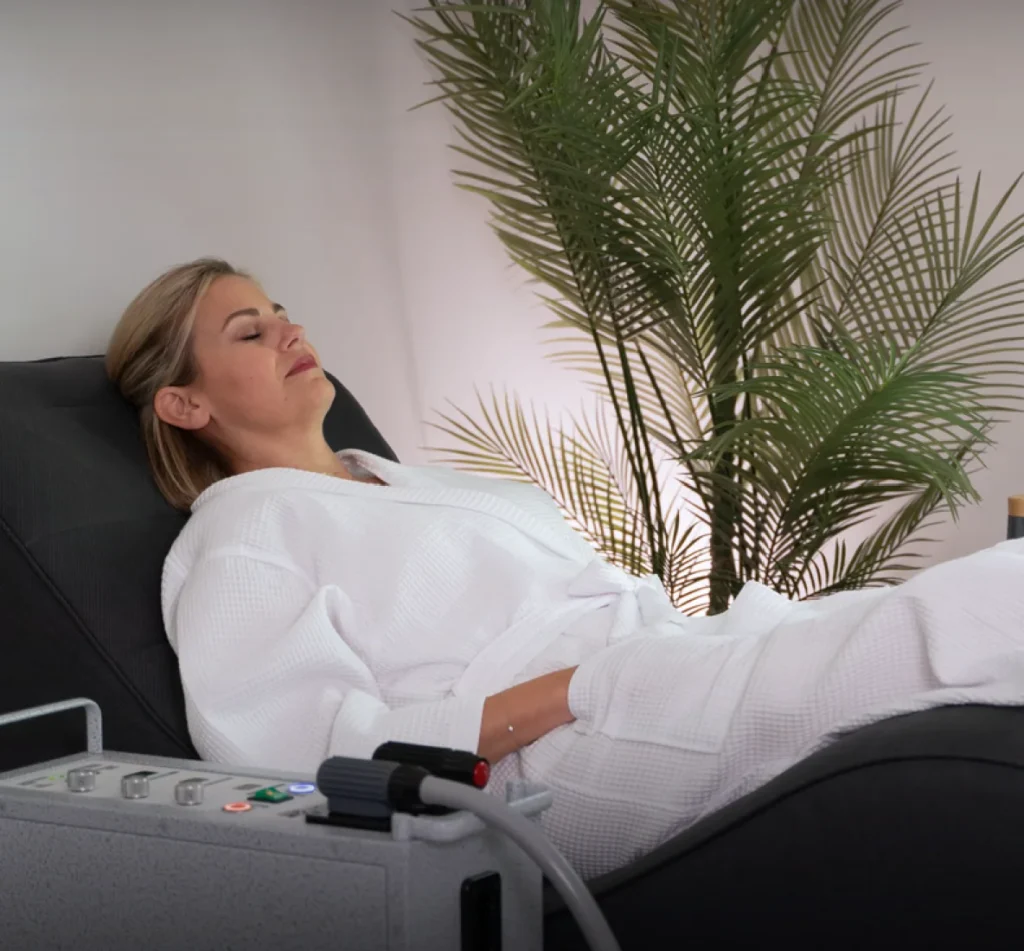
A typical Sisu HBOT session runs 60 to 90 minutes. The user enters the hard-shell chamber, lies back, and the chamber is sealed. Pressure increases gradually over several minutes (called compression) to the target ATA. During the session, the user breathes 95 percent oxygen through a mask. Members can read, listen to music or a podcast, or sleep. At the end of the session, pressure is gradually released (decompression) over several minutes.
Most members feel a mild ear-pressure sensation during compression and decompression, similar to descending in an airplane. The technique for equalizing (yawning, swallowing, or a mild Valsalva maneuver) is taught at the first session. Some members feel slightly tired after the first one or two sessions as the body adapts. Most feel rested or slightly energized after each session once acclimated to the protocol.
HBOT at Sisu is a wellness service, not a medical treatment, and it does not replace foundational training, sleep, nutrition, or stress management.
Experience HBOT at Sisu
Three ways to begin:
- Schedule a free tour: see the studio, meet the team, no commitment.
- Explore membership tiers: pricing, packs, and how mHBOT fits into the Sisu approach.
- Book a single session: drop in and try it.
References
- Hachmo, Y., Hadanny, A., Abu Hamed, R., Daniel-Kotovsky, M., Catalogna, M., Fishlev, G., et al. (2020). Hyperbaric oxygen therapy increases telomere length and decreases immunosenescence in isolated blood cells: a prospective trial. Aging, 12(22), 22445-22456. DOI: 10.18632/aging.202188
- Harch, P. G., Andrews, S. R., Rowe, C. J., Lischka, J. R., Townsend, M. H., Yu, Q., & Mercante, D. E. (2020). Hyperbaric oxygen therapy for mild traumatic brain injury persistent postconcussion syndrome: a randomized controlled trial. Medical Gas Research, 10(1), 8-20. DOI: 10.4103/2045-9912.279978
- Ishii, Y., Deie, M., Adachi, N., Yasunaga, Y., Sharman, P., Miyanaga, Y., & Ochi, M. (2005). Hyperbaric oxygen as an adjuvant for athletes. Sports Medicine, 35(9), 739-746. DOI: 10.2165/00007256-200535090-00001